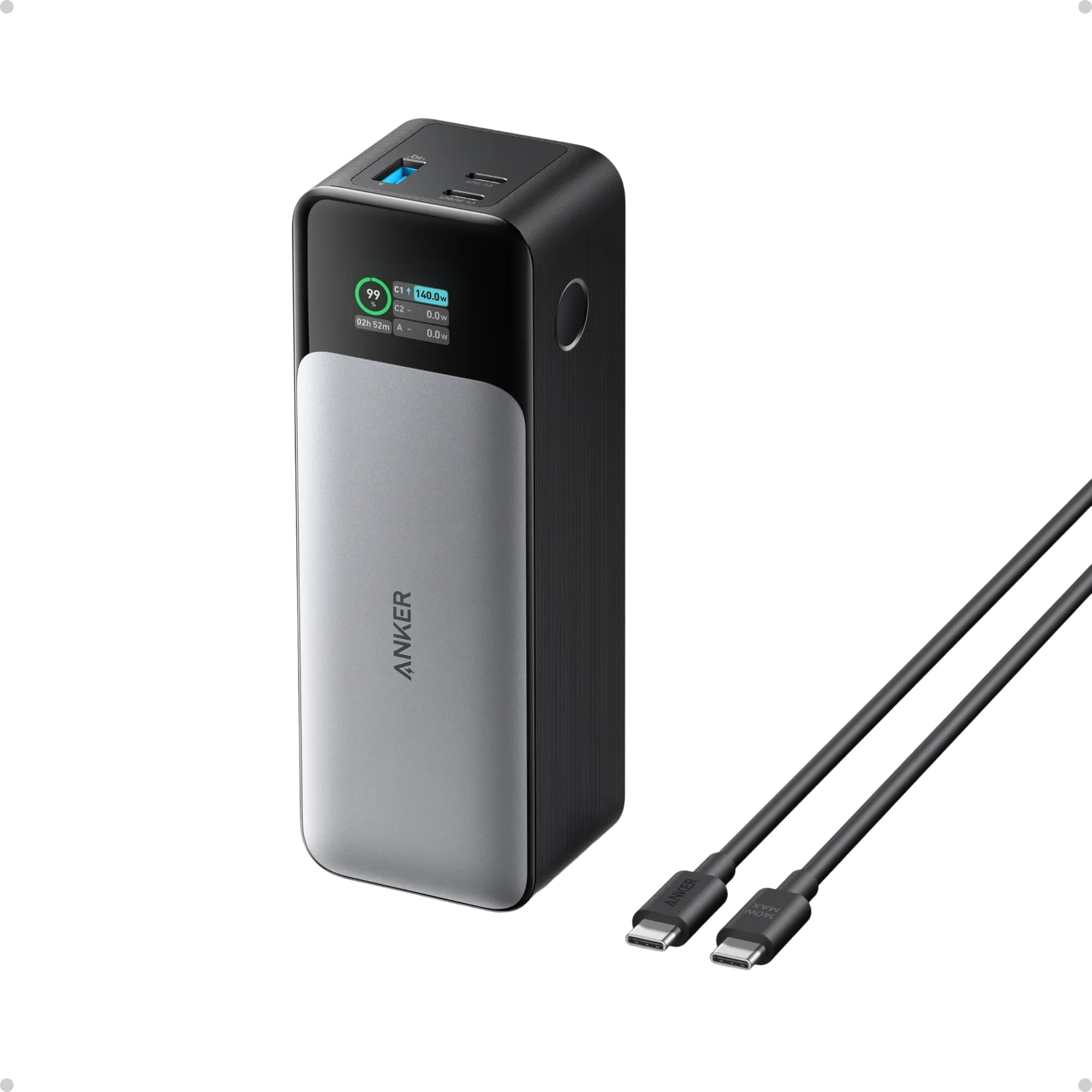
The Anker 737 delivers its headline: 140W of PD 3.1 power from a 24,000mAh pack that refills itself in about an hour and carries a flight-legal 86.4Wh. Usable capacity runs about 27% below the box number, and full list price is steep. On sale — where it spends much of its life — it is the laptop-grade travel battery to beat.
— THE VERDICT · JUDGEANY EDITORSWhat the 737 is
The Anker 737 (PowerCore 24K, model A1289) is Anker's flagship travel battery: a 24,000mAh cell pack — 86.4Wh, just under the 100Wh carry-on limit — that pushes 140W out of a single USB-C port over PD 3.1 (28V/5A) and refills itself at the same 140W. Two USB-C ports and one 18W USB-A share a 140W total budget, and a smart digital display shows per-port wattage plus the estimated time to full or empty. At 630 g and 155.7 x 54.6 x 49.5 mm, this is a brick you carry in a backpack, not a pocket.
The power rules that actually matter
One device on a USB-C port alone can draw the full 140W. Add a second USB-C device and the two split the 140W budget; the USB-A port caps at 18W. Refill speed is the other half of the story: the 737 accepts 140W input, and Archyde measured a complete refill in 63 minutes on a 90W charger — a refill pace few published power-bank tests can match. A double-press of the power button toggles trickle-charge mode for low-draw gadgets like earbuds and wearables, and ActiveShield 2.0 watches cell temperatures while you charge.
What published tests found
BatterySkills' bench work found the 737 taking a 16-inch MacBook Pro from 20% to 80% in 42 minutes — wall-charger territory — and recorded output holding above 130W until the cell dropped to 15%. The smart display proved honest in their testing, staying within ±2% of professional USB meters, and standby drain was just 3% per month. MobileReviews Eh ran the pack through its standard brutal suite — voltage accuracy, efficiency, recharge time, thermal output — and still calls it a top pick years after launch. PCMENA's weeks of use landed close to Anker's published charge counts: nearly five full charges for an iPhone 13 Pro Max. We run no lab; scores below are editorial judgments on this published evidence.
Where the evidence pushes back — and why the verdict still holds
The dissent is substantive. Archyde's lab measured only 13,726mAh of usable output against a theoretical 18,894mAh — roughly 27% lost to conversion — so the 24,000mAh on the box is cell capacity, not what reaches your devices. PCMENA found the three ports competing for power when all are in use at once. An Amazon UK owner running a Legion Go watched the pack drain in about an hour of gaming, a reminder that a gaming handheld drinks watts like a laptop. And pricing is a saga: Android Headlines tracked a Cyber Monday 2024 all-time low of $79.99 against a $149.99 list price, so buying at list is a mistake. Yet no critic disputes the core claim: sustained 140W from a battery you can legally carry on a plane, with a display that tells the truth. The argument is about price and expectations — not performance.
Who should buy it
If your travel kit includes a USB-C laptop — or a Steam Deck or ROG Ally X — and you want to charge it at near-wall speed between outlets, this is the pack. Owners charging only phones and earbuds should buy smaller and cheaper; this is 630 g of overkill for a phone top-up. It spends much of its life discounted — check the live price on Amazon before paying anything near full price.