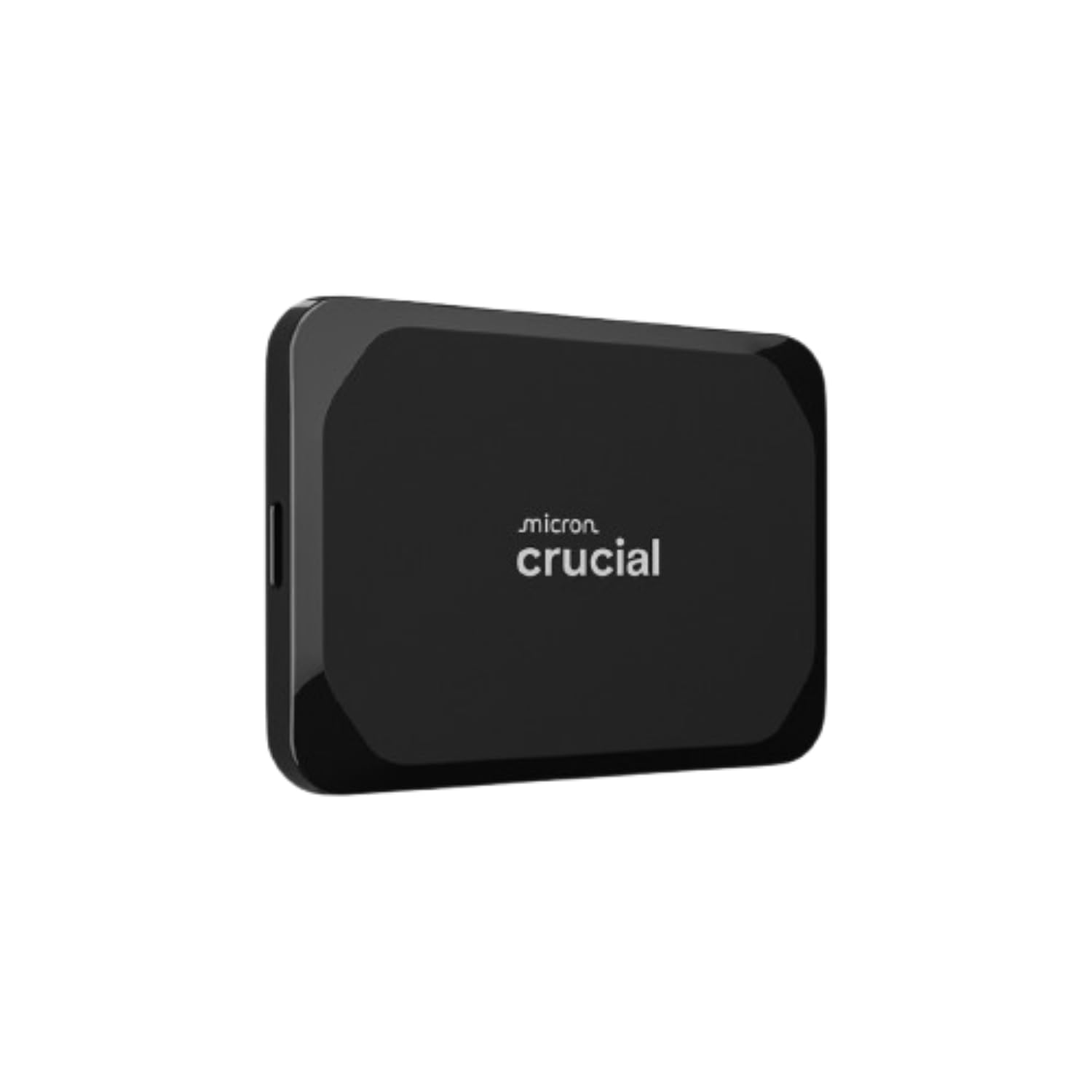
Our editorial verdict, built on published evidence: the Crucial X9 Pro is the portable SSD to beat in the 10Gbps class — small, cool-running, genuinely tough, and historically well-priced, with the 2TB model hitting $106.22 on Amazon in October 2025. The headline 1,050 MB/s is the one thing to discount: no independent test has reached it, though the X9 Pro still lands near the top of every real-world transfer ranking on this interface. The bundled cable is the practical annoyance, and the encryption software's delayed launch explains the oldest complaints. Buy it for backups, photo libraries, and game storage; video pros should step up to the 20Gbps X10 Pro. Check the current price on Amazon.
— THE VERDICT · JUDGEANY EDITORSThe 10Gbps sweet spot, honest numbers included
The Crucial X9 Pro is a USB-C 3.2 Gen 2 portable SSD (10 Gb/s) rated up to 1,050 MB/s read and write, wrapped in anodized aluminum at 38 grams with IP55 dust and water resistance. On September 17, 2023, 9to5Toys reported Amazon all-time lows of $70 for 1TB and $110 for 2TB; on October 1, 2025, the same outlet called $106.22 for the 2TB the lowest Amazon price of the year — check the current price on Amazon before you buy. This review is built from published reviews, lab measurements, and owner feedback. We don't run a test lab: every measurement below belongs to the outlet that published it, and the score is our editorial judgment based on that public evidence.
Speed: fast, just not 1,050 fast
No independent test has hit Crucial's headline number, and the exact shortfall is worth stating plainly. TechAdvisor measured 966 MB/s reads and 970 MB/s writes in CrystalDiskMark on the 2TB model; KitGuru's best write across its suite was 928 MB/s; StorageReview's Blackmagic run landed at 957.9 read and 901.7 write. TechAdvisor puts part of the gap down to USB 3.2 Gen 2 interface overhead: the 10 Gb/s ceiling is real, and no drive on this interface breaks it cleanly. The counterpoint: PCWorld found the X9 Pro leading the 10Gbps pack in real-world 48GB transfers and called it a drive you "can't ask much more from" at this interface. iMore's M2 MacBook Air test hit 1,007.68 read, the closest anyone got to the label. The headline number is marketing — but the drive still ranks near the front of everything on this interface.
Small, cool, and tough
The physical package is the least contested part of the story. At 65×50×10 mm and 38 g it is one of the smallest drives in its class (StorageReview called it the clear size-and-weight winner), with an anodized aluminum shell, a rubberized soft-touch base, IP55 sealing, and a 7.5-foot drop rating. iMore ran it under sustained loads and found it barely warm to the touch, which is more than you can say for some rivals that throttle when they heat up. It ships exFAT, so it works across Windows, Mac, Android, iPad, PlayStation, and Xbox out of the box, and Crucial backs it with a five-year warranty. Best Buy's aggregated reviews show 95–96% of owners would recommend it to a friend.
The rough edges
Three caveats, all documented rather than rumored. First, the launch software: the advertised 256-bit AES hardware encryption with password protection wasn't actually available when the drive shipped, and Android Central's long-term review called the missing password protection "a glaring issue," and TechAdvisor reported Crucial's software team had been blindsided by the hardware schedule. That has since been resolved, but it explains some early one-star reviews. Second, the included USB-C cable: Best Buy's review summaries flag its short length, and one detailed owner found the bundled cable so flaky the drive wouldn't appear on iPhone, Mac, or Windows until they swapped in a third-party USB-C 3.2 Gen 2 cable. Third, a Tom's Hardware forum owner of the 4TB model reported disconnections on every use across ports and cables; a single report, but worth knowing, since no firmware update was available at the time.
Who should buy it
This is a generalist's drive, not a specialist's. PCWorld's reviewer explicitly points video professionals at the faster X10 Pro (20Gbps) instead. But for backups, photo libraries, game storage, and moving big files between machines, the X9 Pro sits in the sweet spot: near the top of its interface class, physically excellent, and historically cheap for what it is. Just budget for a decent third-party cable if the bundled one misbehaves.