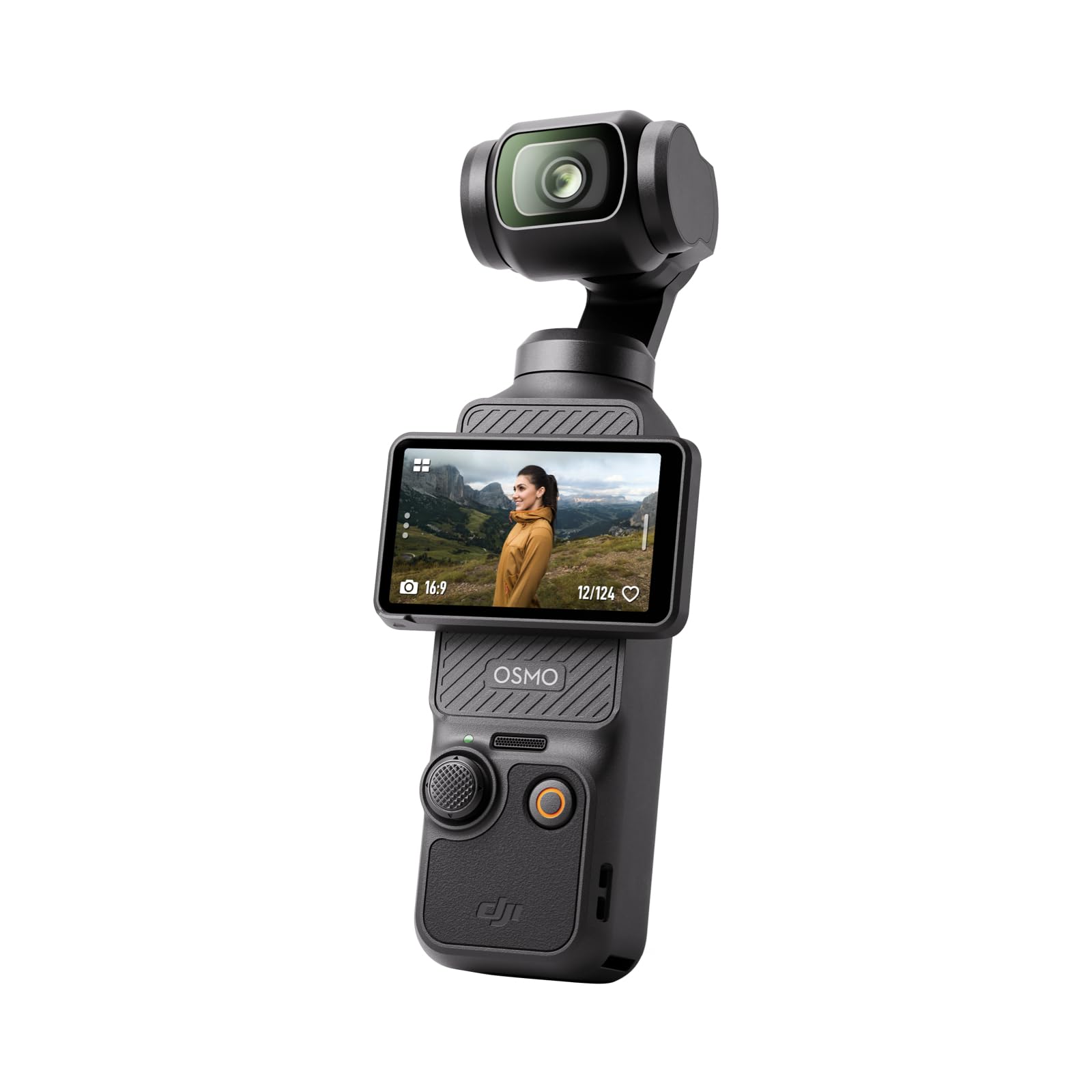
Our editorial verdict, built on published evidence: the DJI Osmo Pocket 3 pairs a 1-inch sensor with three-axis mechanical stabilization to deliver the smoothest pocketable 4K video reviewers have tested, and it single-handedly revived the camcorder market in Japan. The caveats are real: forced online activation through the DJI Mimo app, 4K recording heat limits that range from Tom's Guide's 70-minute lab-room result to an owner's 13-minute case, no waterproofing, and 9.4MP stills. For vloggers and travel creators, especially at sale prices like the $378 Kotaku spotted, it remains an easy recommendation. Check the current price on Amazon.
— THE VERDICT · JUDGEANY EDITORSThe camera that ate the camcorder market
DJI announced the Osmo Pocket 3 in October 2023 at $519, and it went on to do something no camera in years has managed: it revived its whole category. PetaPixel cited BCN+R retail data showing the Pocket 3 took 11% of Japan's camcorder market in its launch month, never dropped below 20% afterward, and peaked at 34.1%, with DJI as a whole holding over 50% of that market. On Amazon it sits at 4.5 stars across 3,300+ reviews and a #2 Best Sellers rank in Camcorders (Kotaku, October 2026). Note that the Osmo Pocket 4 launched in April 2026, but the Pocket 3 is still sold on Amazon with frequent discounts. This review is built from published reviews, lab data, and owner reports. We don't run a test lab: every measurement below belongs to the outlet that published it, and the score is our editorial judgment based on that public evidence.
Video first, stills a distant second
The 1-inch CMOS sensor and 20mm f/2.0 fixed lens shoot 4K/60fps, 4K/120fps slow motion, and true 10-bit D-Log M / HLG footage. TechRadar gave it 4.5/5, calling the video "class-leading" with low-light performance clearly ahead of the Pocket 2. The caveat is photography: stills are only 9.4MP (3840×2160), down sharply from the Pocket 2's resolution. PetaPixel's review sums it up as top-tier video but weak photos, and DPReview forum users say the stills are fine for the web but fall apart when cropped — an iPhone may shoot better stills. Zoom is digital only (2x for photos, 4x for video); there is no optical zoom.
Stabilization is the headline act
The three-axis mechanical gimbal plus ActiveTrack 6.0 face auto-detect is the reason most people buy this camera: footage comes out smooth where phones rely on crops and action cameras still jitter, and Dexerto found the flip-screen-to-shoot workflow the simplest in its class. Audio keeps pace, with three built-in stereo mics and direct pairing for two DJI Mic 2 or Mic Mini transmitters. But the tracking is not infallible, and this is where the coverage splits: Tom's Guide documented occasional gimbal drift in Follow mode that required manual re-centering, and found object tracking lost its subject more easily than face tracking did. It is also not an action camera. Dexerto notes there is no waterproofing (a separate case is required), and the exposed gimbal head is delicate compared with a rugged GoPro-style body.
Heat, battery, and the fine print
DJI rates the 1300mAh battery at 166 minutes, but that is a lab figure and 4K shooting lands far below it. Tom's Guide recorded 70 minutes of continuous 4K/60p at room temperature before an overheat shutdown, calling that holdout "impressive." Individual units do worse: one verified owner (alza.cz, July 2026) reported his unit quitting after about 13 minutes of 4K/60p D-Log M and needing nearly an hour to cool down, and multiple owners online report similar heat issues. Dexerto separately lost footage to SD card corruption during testing, and there is no built-in storage — you supply your own microSD (up to 1TB), and the charger is sold separately. On the plus side, PD fast charging reaches 80% in 16 minutes with DJI's 65W PD charger (lab figure), and DroneXL's 18-month long-term review puts real-world battery life around two hours depending on frame rate, gimbal load, and temperature.
The biggest fine print has nothing to do with specs. PetaPixel found the Pocket 3 requires online activation through the DJI Mimo app: a handful of uses without activating, and the camera locks until you do. The reviewer called that unacceptable on a $700-class device. Be aware the companion Mimo app must be sideloaded as an APK from DJI's own site. Cybernews (2026) lists forced app activation, no built-in storage, and heavy touchscreen dependence among its cons.
Who it is actually for
This is a video-first tool for vloggers, travel creators, and anyone who wants smooth 4K footage without rigging up a mirrorless camera. If you shoot mostly photos, want a waterproof body, or expect a camera to work with no app in the loop, look elsewhere. Pricing is volatile, so check the current price on Amazon: around October 2026, Kotaku reported the standard kit at $378, calling it the Amazon all-time low.