JudgeAny EST. 2026
ReviewComputingNº 110 · Updated 2026-10-08

LG UltraGear 32GS95UE Review: The 4K240 OLED That Doubles as a 480Hz Esports Panel

LG 32GS95UE review: 32-inch 4K240 OLED with a VESA-certified 1080p480 dual mode. Measured input lag, the HDR debate, and the divisive coating.

Words JudgeAny EditorsRead 3 minUpdated 2026-10-08Prices live on Amazon
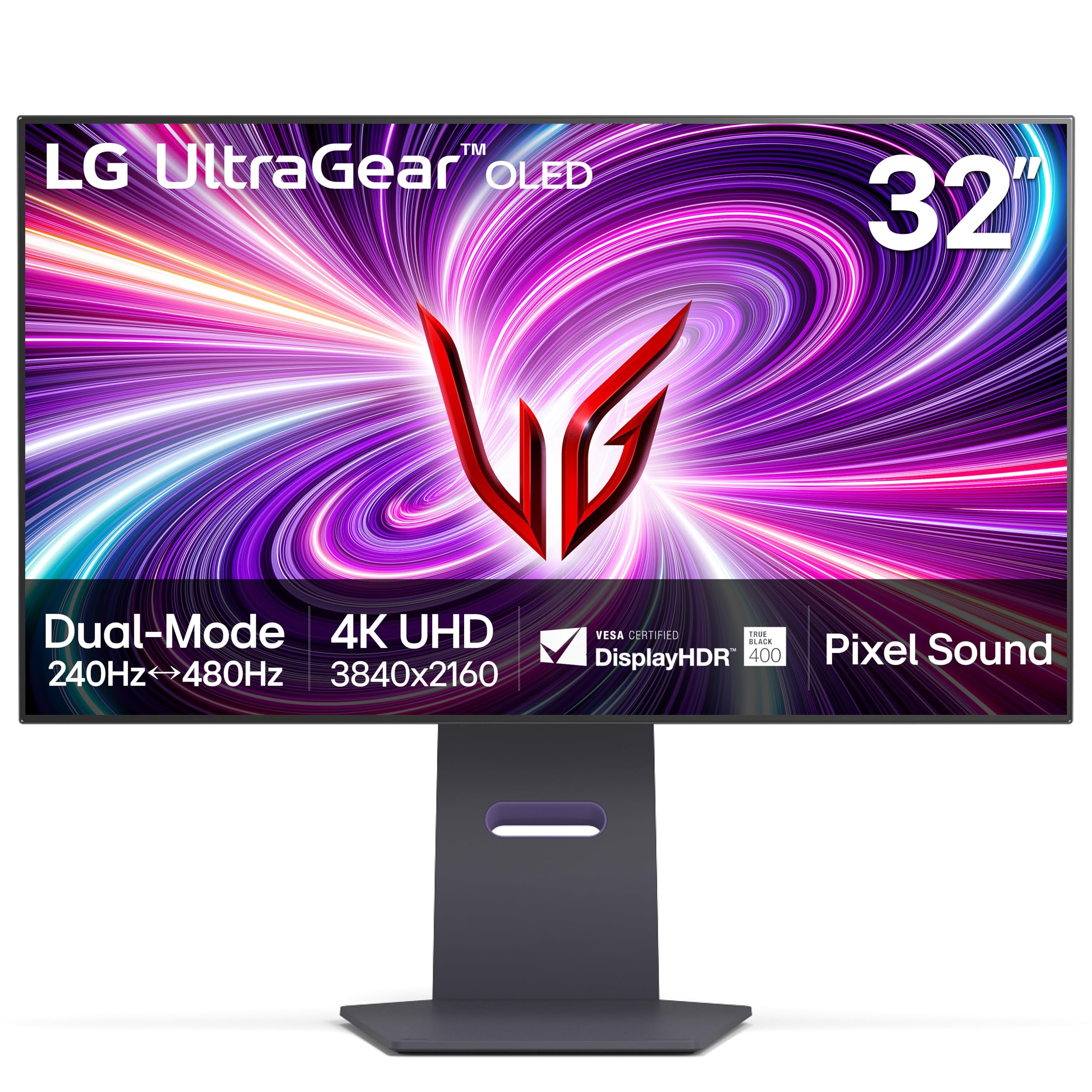
LG UltraGear 32GS95UE 32" 4K OLED Gaming Monitor
JA 8.4
Fig. 01 — LG UltraGear 32GS95UE 32" 4K OLED Gaming MonitorMargin notes · sourced

The LG 32GS95UE is the rare 'two monitors in one' trick that works: a 32-inch 4K 240Hz OLED with a VESA-certified 1080p 480Hz dual mode, near-zero input lag measured by TechSpot, and text clarity that finally fixes WOLED fringing. The matte coating, missing USB-C, and steep launch price are the catches. Check the current price on Amazon.

— THE VERDICT · JUDGEANY EDITORS

One monitor, two refresh rates, zero gimmick

The LG UltraGear 32GS95UE is a 32-inch flat 4K OLED gaming monitor built around a party trick that turned out to be real: the world's first VESA-certified Dual-Mode panel, switching between 3840x2160 at 240Hz and 1920x1080 at 480Hz with a hotkey (LG press release). It launched at $1,399.99 in 2024, staking the claim that one display can serve both cinematic single-player games and competitive esports. This review aggregates manufacturer specs, published measurements, and owner impressions. We don't run a test lab; every number below names the outlet that published it, with test conditions where stated, and the scores are editorial judgments built on that evidence.

The dual-mode trick actually works

Dual-Mode is the reason this monitor exists, and it survives scrutiny. TechSpot measured processing delay at 0.3ms in 4K 240Hz mode and 0.5ms in 1080p 480Hz mode — effectively no penalty for the mode switch, with total input lag lower in 480Hz simply because the refresh is faster. TFTCentral confirmed very low input lag and very good console support across both modes. The honest caveat comes from PC Gamer: the 1080p image looks better than plain interpolation but "still a softness that belies any true pretence at native rendering" at 32 inches. Treat Dual-Mode as an esports extra — a welcome one, in PC Gamer's words — not as a second desktop resolution.

Picture: OLED does what OLED does

Infinite contrast needs no defending: TFTCentral praised better ambient contrast and black depth than QD-OLED panels, and Trusted Reviews measured black level 0 with DCI-P3 97.4%, sRGB 100%, and a ΔE of 2.9. Text clarity — the historic WOLED weakness — is "very good" per TFTCentral, whose reviewers found the new sub-pixel layout largely fixed the fringing problem. HDR is where reviewers split. TechSpot measured 1,140 nits at a 2% window (about 15% above typical QD-OLED) but only 270–280 nits full-screen; Tom's Guide averaged ~250 nits across the screen in HDR, found enabling HDR on the PC made the panel dimmer, and filed "Dim HDR" as a con. The difference is ABL: WOLED's full-screen brightness caps hard, while small highlights punch. Bright-room buyers should read the full-screen numbers, not the peak.

The spec-sheet gaps

No USB-C and no DisplayPort 2.1 — the two most widely noted omissions — plus no KVM switch for the price class. TFTCentral's cons add no black-frame insertion and no Dolby Vision, and found the sRGB emulation "could have been a little more accurate." The anti-glare coating is genuinely divisive: Dexerto tested it under a window with a light bar and called it great, while owner forums widely call it grainy next to glossy QD-OLED panels. Tom's Guide found the Pixel Sound speakers thin and underwhelming despite the DTS Virtual:X branding. And TechSpot noted it draws ~47W on a full-screen white page versus 32W for the QD-OLED ASUS PG32UCDM — WOLED still pays for white.

Who should buy it

Buy the 32GS95UE if you play both cinematic and competitive games and want one desk, one monitor: PC Gamer judged it "clearly, if only marginally, best in class," and Trusted Reviews called it one of the best options anywhere for esports and single-player gaming. Owners note the ASUS PG32UCDP/PG32UCDM covers the same panel class for less money, so compare street prices. Skip it for bright rooms (full-screen SDR sits around 250–275 nits), skip it if you need USB-C single-cable docking, and wait for a deal — Tom's Guide logged $949 at Amazon in July 2025 against the $1,399.99 launch price. Check the current price on Amazon.

On Film

Video review · third-party footage, not filmed by JudgeAny
LG UltraGear OLED (32GS95UE) Review | A Gaming Monitor Like No Other · Digital TrendsVia YouTube
Picture qualityInfinite contrast · fringing fixed (TFTCentral)9.0
HDR1,146 nits measured (Trusted Reviews) · full-screen ~250 nits (Tom's Guide)8.0
Motion & response0.03ms GtG · 0.3ms processing delay (TechSpot)9.5
Dual-modeVESA-certified 4K240/1080p480 · 1080p soft at 32 in8.6
Features & connectivityNo USB-C, no DP 2.1, no KVM7.4
Design & buildFull ergonomics · VESA 100 · Pixel Sound thin (Tom's Guide)8.2
Value$1,399 launch; $949 logged (Tom's Guide)7.2
JudgeAny Score8.4

The Dossier

Technical file · compiled from specs & reviews
Panel31.5 in flat 4K UHD WOLED · 3840x2160 · 16:9 · AGLR anti-glare
Dual-Mode3840x2160@240Hz ↔ 1920x1080@480Hz · hotkey switchable (VESA-certified)
Response0.03ms GtG · 0.3ms processing delay at 4K240 (TechSpot)
HDRDisplayHDR True Black 400 · HDR10 (no Dolby Vision) · peak 1300 cd/m² @1.5% APL
Color98.5% DCI-P3 (CIE1976) · factory calibrated · HW calibration ready
VRRG-SYNC Compatible · FreeSync Premium Pro · VESA AdaptiveSync · ClearMR 13000
Inputs2x HDMI 2.1 · DP 1.4 (DSC) · USB 3.0 hub · headphone out · no USB-C / DP 2.1
AudioPixel Sound panel speakers + woofer · 10W x2 · DTS Virtual:X
StandTilt / height / swivel / pivot · VESA 100x100

+ WHAT EARNS IT

  • Dual-Mode actually works: TechSpot measured 0.3ms processing delay at 4K240 and 0.5ms at 1080p480 — no mode-switch penalty
  • Near-zero motion blur: 0.03ms GtG response with ClearMR 13000 VESA certification
  • Text clarity finally fixed for WOLED — TFTCentral rates the new sub-pixel layout 'very good'
  • Strong HDR highlights: 1,140–1,146 nits measured at small windows (TechSpot, Trusted Reviews)
  • Full ergonomics (height/tilt/swivel/pivot) plus 100x100 VESA mounting

− WHAT COSTS IT

  • No USB-C, no DisplayPort 2.1, and no KVM — widely noted omissions at this price
  • Matte anti-glare coating is divisive: grainy next to glossy QD-OLED panels, say many owners
  • Full-screen brightness is modest (~250–275 nits SDR); Tom's Guide called the HDR 'dim' at full-screen average
  • 1080p dual mode is visibly soft at 32 inches — an esports extra, not a desktop resolution (PC Gamer)
  • Pixel Sound speakers sound thin despite the DTS Virtual:X branding (Tom's Guide)
  • $1,399.99 launch price felt steep; the ASUS PG32UCDP/PG32UCDM covers the same panel class for less (owners)

Keep comparing

Same evidence standard · our reviews

Sources

Every major conclusion above maps to a source here · see our methodology.

Questions, answered

Is the 1080p 480Hz mode actually usable?
For esports, yes; for desktop, no. TechSpot measured only 0.5ms processing delay in 1080p 480Hz mode — no mode-switch penalty — but PC Gamer found 'a softness that belies any true pretence at native rendering' at 32 inches. Use 480Hz for competitive shooters and 4K 240Hz for everything else.
Is the HDR good or dim?
It depends on what you measure. Trusted Reviews measured 1,146 nits HDR and TechSpot hit 1,140 nits at a 2% window — strong highlights. Tom's Guide measured ~250 nits average across the full screen and called the HDR dim. WOLED's automatic brightness limiter caps full-screen output while small highlights punch, so judge by your use case: bright rooms favor the full-screen number.
Does it have USB-C or a KVM switch?
Neither — the most widely noted omission. You get two HDMI 2.1 ports, one DisplayPort 1.4 with DSC, a USB 3.0 hub, and a headphone-out jack. There's no DP 2.1 either, so single-cable USB-C docking and KVM switching are off the table.
Should I worry about OLED burn-in?
Owner forums generally accept it with mitigation: the monitor includes OLED care features (screen move, cleaning cycles), and owners recommend hiding the taskbar and varying content. It's a consideration for static desktop work, not a dealbreaker for most gaming use.
How does it compare to the ASUS PG32UCDP?
Owners report the ASUS covering the same WOLED panel class for less money, so compare street prices before committing. PC Gamer judged the LG 'clearly, if only marginally, best in class' overall — the premium buys the dual-mode implementation and calibration, not a different panel.
FILED UNDER · BEST COMPUTING 2026

The one to buy.

The LG 32GS95UE is the rare 'two monitors in one' trick that works: a 32-inch 4K 240Hz OLED with a VESA-certified 1080p 480Hz dual mode, near-zero input lag measured by TechSpot, and text clarity that finally fixes WOLED fringing. The matte coating, missing USB-C, and steep launch price are the catches. Check the current price on Amazon.

As an Amazon Associate, JudgeAny earns from qualifying purchases. Price and availability are accurate as of the date/time indicated and are subject to change.

LG UltraGear 32GS95UE 32" 4K OLED Gaming MonitorLG
Check Price